How Florida Courts Read Public Records Exemptions: Narrowly
TL;DR
Florida public records law starts with a simple rule. Records are open. Only the Legislature can carve out an exemption, and courts read those exemptions narrowly. When an agency says a record is exempt, the agency must prove it. When a court is in doubt, it sides with disclosure. That rule shapes how you talk to a custodian who claims an exemption. Ask which statute. Ask which words in the statute. Push back when the agency stretches the exemption beyond what the law says.
What does it mean that Florida courts read public records exemptions narrowly?
Florida public policy favors open records. The Public Records Act is "construed liberally in favor of openness, and exemptions from disclosure are construed narrowly and limited to their designated purpose." City of Miami Beach v. Miami New Times, LLC, 314 So. 3d 562, 565 (Fla. 3d DCA 2020).
That means a court will not stretch the words of an exemption to cover a record that does not fit squarely within them. If an agency claims an exemption, the court asks whether the specific words of that exemption actually reach the specific record. An exemption that covers "personnel records of law enforcement officers" does not cover every document that mentions a law enforcement officer.
The general purpose of Chapter 119, Florida Statutes, is to open public records so that Florida citizens can discover the actions of their government. Christy v. Palm Beach County Sheriff's Office, 698 So. 2d 1365, 1366 (Fla. 4th DCA 1997). That purpose is the background against which courts read every exemption.
Who has the burden of proving a public records exemption in Florida?
The agency carries the burden. An agency claiming an exemption from disclosure must prove the right to the exemption. Barfield v. School Board of Manatee County, 135 So. 3d 560, 562 (Fla. 2d DCA 2014).
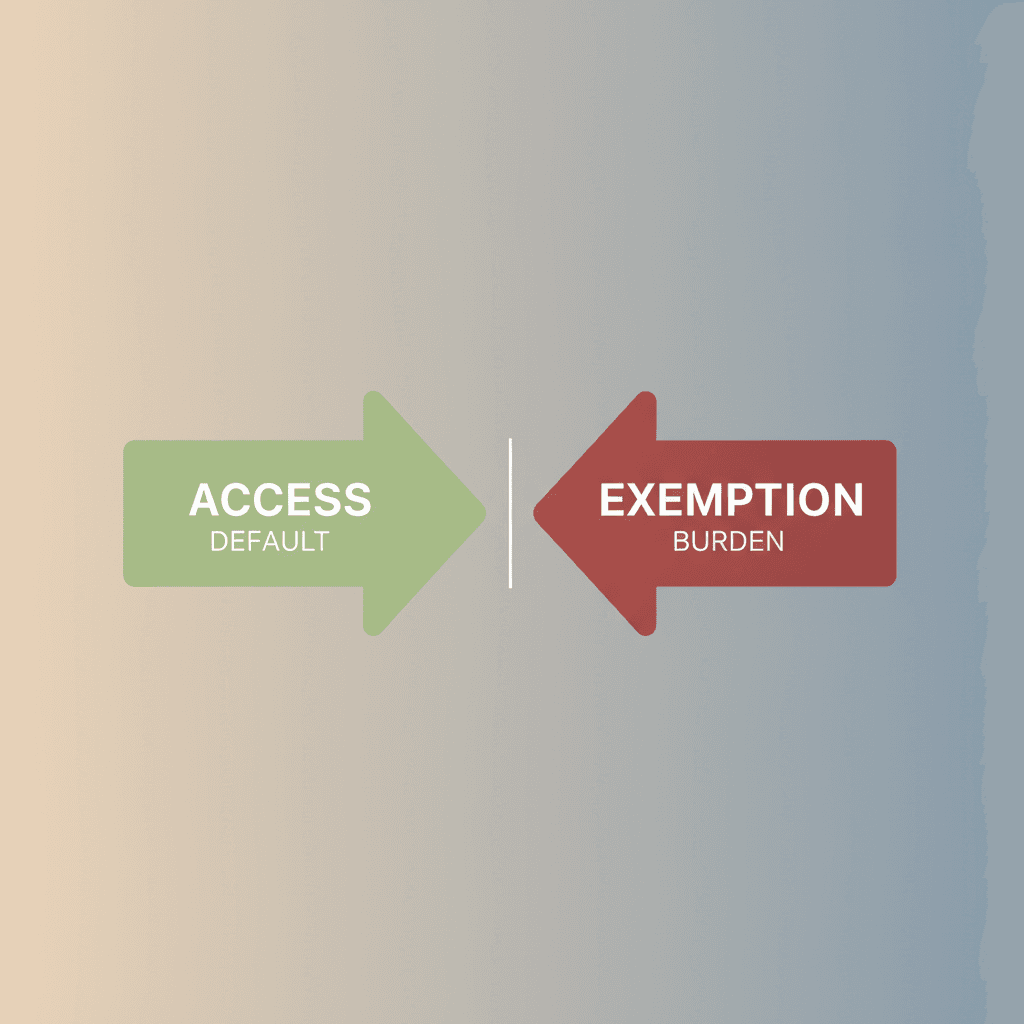
This is the opposite of how many people think it works. Many requesters assume they need to prove that a record is public. They do not. The starting point is that the record is public. Article I, Section 24(a) of the Florida Constitution gives every person a right to inspect or copy any public record. Section 119.07(1)(a), Florida Statutes, requires the custodian to permit inspection and copying. The record is open unless the agency can show otherwise.
If the agency cannot name a specific statutory or constitutional exemption and explain how its words reach the record in question, the agency has not met its burden.
What happens when a Florida court is in doubt about whether a record is exempt?
When the court cannot tell clearly whether an exemption applies, it resolves the doubt in favor of disclosure, not secrecy. Tribune Company v. Public Records, 493 So. 2d 480, 483 (Fla. 2d DCA 1986).
This rule is separate from the narrow-reading rule. The narrow-reading rule tells the court how to read the words of an exemption. The doubt rule tells the court what to do when the answer is still not clear after reading the words carefully. The answer is: let the record go.
Together, these two rules mean agencies face a two-step burden. First, their exemption must cover the record when read in its plain terms. Second, even if the words are ambiguous, ambiguity breaks for the requester.
Why does Florida law work this way?
Two reasons. First, the constitutional access right. The Florida Constitution at Article I, Section 24, puts the right to inspect public records on the same level as other fundamental rights. Read more about that at the constitutional right of access at Article I, Section 24.
Second, only the Legislature can create a public records exemption. An exemption is a provision of general law that takes a record outside the access requirements. Section 119.011(8), Florida Statutes. Courts cannot invent new exemptions. The Public Records Act "excludes any judicially created privilege of confidentiality." Wait v. Florida Power and Light Company, 372 So. 2d 420, 425 (Fla. 1979). When an agency argues for an exemption that is not in the statute, a court cannot create one for them.
For how Florida public records exemptions are created and reviewed, see how Florida public records exemptions are created and sunset under Section 119.15.
How does the narrow-reading rule help me when I make a request?
The rule does not always win at the front counter. It wins in court. But knowing the rule changes how you write the request and the follow-up. An agency that knows you understand the doctrine is more careful about invoking a broad exemption it cannot defend.
Ask which statute the agency relies on
When an agency denies your request, ask them to identify the specific statute they claim exempts the record. Section 119.07(1)(f), Florida Statutes, requires them to state the basis for any denial in writing when you ask. "Agency policy" and "sensitivity concerns" are not enough. They need a statutory citation.
Ask which words in the statute cover your record
Once you have the statute, ask the agency to explain which words in that statute reach your specific record. A broad exemption category may not cover the particular document you want. The narrow-reading rule says courts will not stretch the category to cover things that are not in it.
Push back when the agency stretches an exemption
Agencies often invoke exemptions in broader terms than the statute supports. A body-cam exemption for footage inside a private residence does not cover all body-cam footage. An active-investigation exemption ends when the investigation ends. Knowing that courts will not read the exemption broadly gives you grounds to push back in writing before going to court.
For specific exemption guidance, see articles on the active criminal investigative information exemption and the law enforcement personnel exemption.
What this rule does not do
The narrow-reading rule does not erase exemptions the Legislature has properly enacted. When a statute clearly and specifically covers a record, the record is exempt. The rule limits agencies from stretching exemptions beyond what the statute says. It does not limit exemptions that are clearly written and clearly applicable.
When part of a record is exempt and the rest is not, the agency must separate them. The non-exempt portions come out with the exempt parts redacted. Ask for the non-exempt portions even when an exemption applies to part of the file.
Related
- Florida Constitution Article I, Section 24: your right to public records
- How Florida public records exemptions are created and sunset under Section 119.15
- What to do if your Florida public records request is denied
- Are records of an active criminal investigation public in Florida?
- Are sealed or expunged records still accessible in Florida?
- Are body cam recordings public records in Florida?
Frequently asked questions
- How do Florida courts read public records exemptions?
- Narrowly. Florida public policy favors disclosure. The Public Records Act is read liberally in favor of openness, and exemptions are construed narrowly and limited to their designated purpose. City of Miami Beach v. Miami New Times, LLC, 314 So. 3d 562, 565 (Fla. 3d DCA 2020).
- Who has the burden of proving a public records exemption in Florida?
- The agency. An agency claiming an exemption from disclosure bears the burden of proving the right to the exemption. Barfield v. School Board of Manatee County, 135 So. 3d 560, 562 (Fla. 2d DCA 2014).
- What happens if a Florida court is in doubt about whether a record is exempt?
- Doubt about whether an exemption applies is resolved in favor of disclosure, not secrecy. Tribune Company v. Public Records, 493 So. 2d 480, 483 (Fla. 2d DCA 1986).
- Can a Florida judge create a new public records exemption?
- No. Only the Legislature can create exemptions. Courts cannot create privileges of confidentiality under the Public Records Act. Wait v. Florida Power and Light Company, 372 So. 2d 420, 425 (Fla. 1979).
- If part of a record is exempt, can the agency withhold the whole record?
- No. The agency must produce the non-exempt portions with the exempt parts redacted. Ask for the non-exempt portions even when part of the file is exempt.
- How should I respond when an agency says a record is exempt?
- Ask for the specific statute. Ask which words in that statute cover your record. If the agency is redacting only part of a record, ask which words in the statute justify each redaction.
Not legal advice. Educational and informational content only. Reading this site does not create an attorney-client relationship. For advice on a specific matter, consult a licensed Florida attorney.