Florida Constitution Article I, Section 24: Your Right to Public Records

TL;DR
Florida's right to public records is more than a statute. It is written into the state Constitution at Article I, Section 24. Every person can inspect or copy any record made or received in connection with the official business of any public body, officer, or employee. The Legislature can carve out an exemption only by a two-thirds vote, only by a law that states a public necessity, and only as narrowly as needed. Courts read this constitutional access right broadly and exemptions narrowly.
What does Article I, Section 24 of the Florida Constitution say?
Article I, Section 24(a) of the Florida Constitution says:
Every person has the right to inspect or copy any public record made or received in connection with the official business of any public body, officer, or employee of the state, or persons acting on their behalf, except with respect to records exempted pursuant to this section or specifically made confidential by this Constitution.
That is a broad right. It covers every person, every format, and every public body in Florida. The only records outside it are records the Legislature has validly exempted or the Constitution itself has made confidential.
The Florida Supreme Court has described this access right as a fundamental constitutional right. In Rhea v. District Board of Trustees of Santa Fe College, 109 So. 3d 851, 855 (Fla. 1st DCA 2013), the court put it plainly: "A citizen's access to public records is a fundamental constitutional right in Florida."
Why does Florida's right to public records live in the Constitution?
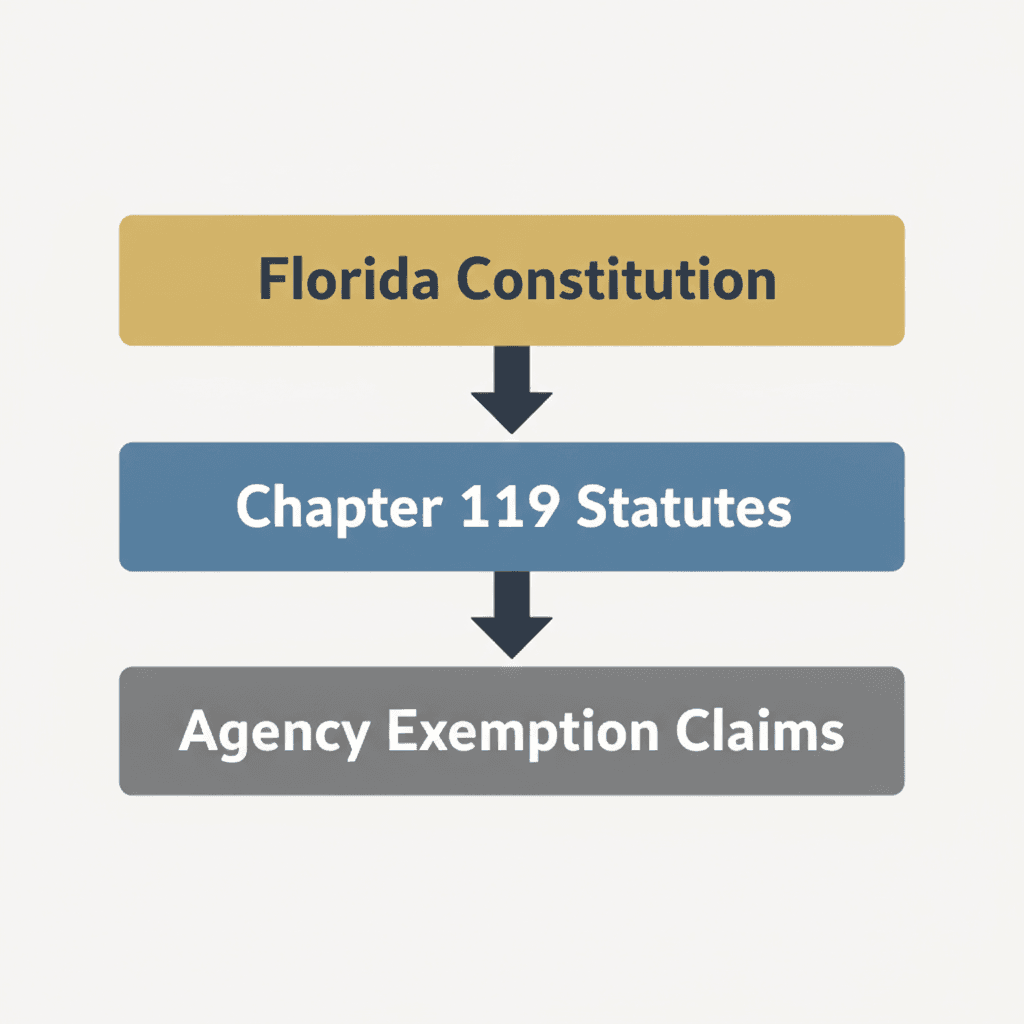
Florida voters added Article I, Section 24, to the Constitution in 1992. It took effect in 1993. The move put the access right above the reach of ordinary legislation. A simple majority in the Legislature can change a statute. It cannot change the Constitution the same way.
Before the amendment, Chapter 119 of the Florida Statutes carried the access right. The Constitution now sets the floor. The statute implements it with procedures, fee caps, and exemptions. When a statute and the Constitution conflict, the Constitution wins.
The Florida Supreme Court has described this posture in State ex rel. Clayton v. Board of Regents, 635 So. 2d 937 (Fla. 1994): public officials must conduct public business in the open and public records must be available to all members of the public. That standard comes from the Constitution.
What does Article I, Section 24 cover?
The constitutional access right applies to virtually all state and local government in Florida.
All three branches of state government
The Legislature, the executive branch agencies, and the courts all fall under Article I, Section 24. This is not an executive-only rule. It reaches lawmakers and judges too.
Counties, municipalities, and districts
County governments, city governments, school boards, water-management districts, and similar local entities are all covered. The access right runs from the statehouse to the smallest local board.
Persons acting on the government's behalf
When a private contractor does work that a public agency would otherwise do itself, the constitutional access right can reach that contractor's records. The statute implements this through the definition of "agency" in Section 119.011(2), Florida Statutes, and the "acting on behalf of" test.
For more on how that test works, see what governmental entities are covered by Florida's Public Records Act.
How can the Florida Legislature create an exemption?
Article I, Section 24(c) lets the Legislature carve out exemptions. But it sets three conditions. All three must be met.
The two-thirds vote rule
A public records exemption is not a normal bill. It needs a two-thirds vote of the membership of each house of the Legislature. A simple majority is not enough. This makes creating or expanding an exemption harder than passing most laws.
The public necessity statement
The law creating the exemption must state the public necessity justifying it. "We thought this was a good idea" is not enough. The Legislature has to explain why keeping these records secret serves a genuine public purpose.
The narrow-tailoring requirement
The exemption must be no broader than necessary to accomplish the stated purpose. An agency cannot claim a sweeping exemption when a narrow one would do the job. The courts enforce this limit.
To understand how Florida courts apply these limits when agencies stretch an exemption, read how Florida courts read public records exemptions narrowly.
What about exemptions that existed before 1993?
Article I, Section 24(d), grandfathered laws that limited public access and were in effect on July 1, 1993. Those laws remain in effect until the Legislature repeals them. Court rules that limited access before the amendment also remain in effect.
This means that some older exemptions on the books today were never required to go through the two-thirds vote, public necessity, and narrow-tailoring process. They survived by virtue of the date they existed. New exemptions and changes to old ones must still meet the full constitutional standard.
How do Florida courts read Article I, Section 24?
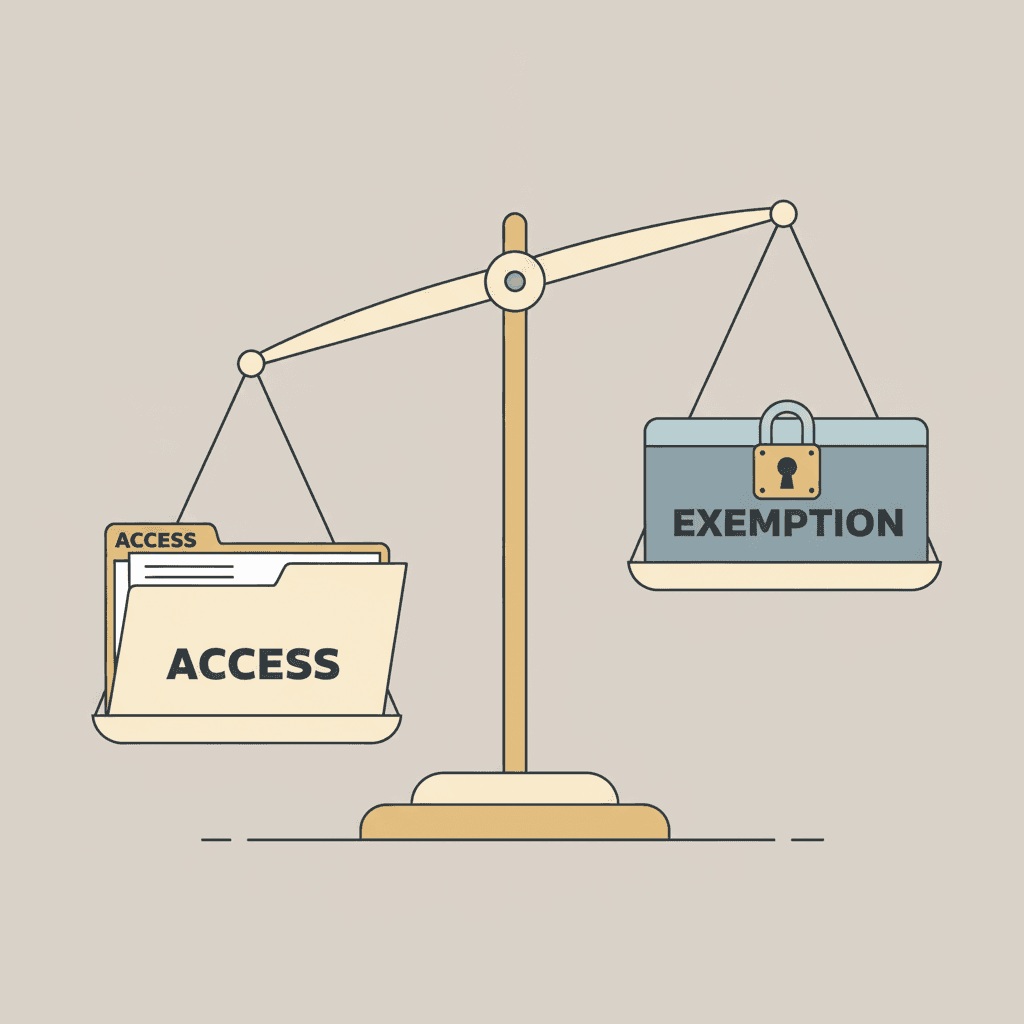
Florida courts read the access right broadly and exemptions narrowly. This is not just a policy preference. It flows from the constitutional text and the position of the access right as a fundamental right.
In practice, this means the burden falls on the agency. When an agency claims a record is exempt, the agency must point to a specific statutory or constitutional exemption. A policy preference, an internal rule, or a general sense that the record is sensitive does not qualify.
When a court is in doubt about whether an exemption applies, it resolves that doubt in favor of disclosure.
How does this affect a public records request I send today?
When you send a public records request and an agency refuses, the constitutional right is what you are pressing. You are not asking a favor. You are asserting a right that the state's highest law protects.
If the agency refuses without pointing to a specific exemption, you can ask for the basis in writing. Section 119.07(1)(f), Florida Statutes, requires the agency to state the basis for any denial in writing when you ask. The constitutional access right is what makes that demand meaningful. An agency cannot rest on internal policy alone.
For next steps when an agency stalls or denies, start with what to do when an agency ignores your request. For denials, see what to do if your request is denied.
Related
- What is a public record under Florida law?
- The "in connection with official business" test, explained
- What governmental entities are covered by Florida's Public Records Act?
- How Florida courts read public records exemptions: narrowly
- Are emails to and from Florida government officials public records?
Frequently asked questions
- Where is Florida's right to public records written?
- It is written in Article I, Section 24, of the Florida Constitution and implemented by Chapter 119 of the Florida Statutes. The Constitution gives every person the right to inspect or copy public records made or received in connection with official business.
- Does the Florida Constitution cover all branches of government?
- Yes. Article I, Section 24, applies to the legislative, executive, and judicial branches, plus counties, municipalities, districts, and persons acting on the government's behalf.
- Can the Legislature create a new public records exemption by majority vote?
- No. Article I, Section 24(c), requires a two-thirds vote of the membership of each house, a public necessity statement, and language no broader than necessary.
- Are old Florida public records exemptions still valid after the constitutional amendment?
- Some are. Article I, Section 24(d), preserves laws limiting access that were in effect on July 1, 1993, and certain court rules adopted before the amendment.
- How do Florida courts interpret the access right on close calls?
- Florida courts read the access right broadly and exemptions narrowly. The Florida Supreme Court has called public records access a fundamental constitutional right in Florida.
- What does this mean for a public records request I send today?
- If an agency refuses, you can point to Article I, Section 24, and ask the agency to identify the specific statutory or constitutional exemption it is relying on. Section 119.07(1)(f), Florida Statutes, requires the agency to state the basis for any denial in writing when asked.
Not legal advice. Educational and informational content only. Reading this site does not create an attorney-client relationship. For advice on a specific matter, consult a licensed Florida attorney.